
Web Speed: The Technical Detail That Defines Your Communication and Sales Strategy
Why your website's speed isn't a technical detail but a business decision that affects your communication, sales, and search ranking.
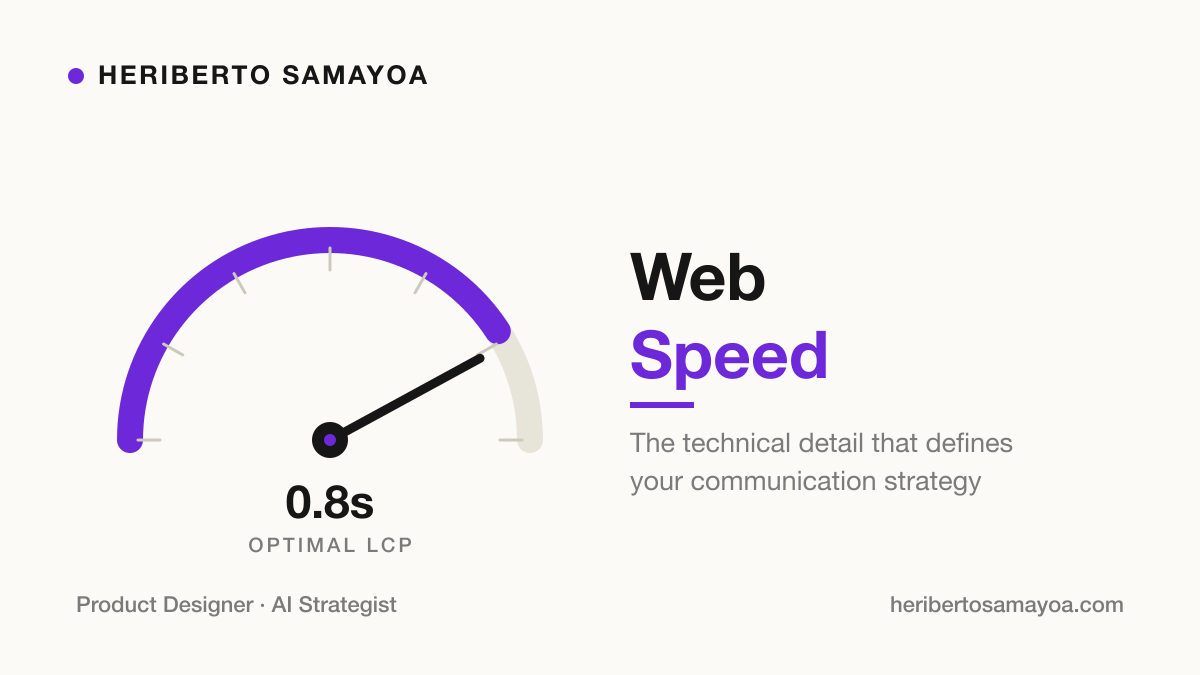
A site that takes three seconds to load isn’t an “almost ready” site. It’s a site that’s losing customers, authority, and search ranking on every visit. Web speed is often treated as a technical detail, something to “fix later.” But the reality is different: speed is a business decision, and it affects how you’re perceived, how much you sell, and whether people find you on Google.
The real cost of a slow website
The data is stark. Every additional second of load time reduces conversions. Google found years ago that moving from 0.4 to 0.9 seconds in mobile search already cut traffic and ad revenue. Studies from Walmart, Amazon, and Akamai showed the same pattern: every 100 ms or every second of delay translates into a measurable drop in sales.
On mobile, the bar is even higher. Half of users abandon a site that takes more than three seconds to load. And once someone leaves, they rarely come back.
Speed and brand communication
Your website is your digital spokesperson. A slow site communicates, without saying a word, messages that contradict your entire communication strategy:
- “We’re not professional.”
- “We don’t care about your time.”
- “We’re not reliable.”
You can invest in impeccable design, persuasive copy, and a strong brand, but if the page is slow to appear, the visitor will never see any of it. Speed is the anteroom of your brand: if the door takes too long to open, no one steps in to discover the rest.
Speed and sales
In e-commerce and lead generation, speed is revenue directly:
- Faster → more pages viewed per session.
- Less abandonment → more conversion opportunities.
- Better experience → more trust at checkout.
A checkout that feels instant drives more purchases than one that hesitates. Friction kills the sale, and slowness is the most invisible and most lethal form of friction.
Speed and SEO: Core Web Vitals
Google uses speed and user-experience metrics (the Core Web Vitals) as a ranking factor. A fast site not only retains more users, it also ranks higher in search results. It’s a double benefit: more visibility and better conversion.
The three key metrics:
- LCP (Largest Contentful Paint): how long until the main content appears.
- INP (Interaction to Next Paint): how fast interactions feel.
- CLS (Cumulative Layout Shift): how much the page “jumps” while loading.
How to start improving
You don’t need to rebuild your site from scratch. The highest-impact improvements are usually:
- Optimized images — the number-one factor. Modern formats (WebP, AVIF), correct sizes, and lazy loading.
- Hosting and CDN — a good server and a content delivery network drastically reduce response times.
- Lightweight code — less unnecessary JavaScript and critical CSS first.
- Caching — leverage browser and server caching so you don’t rebuild everything on every visit.
- Constant measurement — PageSpeed Insights, Lighthouse, and Search Console tell you exactly what to fix.
Conclusion
Speed isn’t a technical tweak you do at the end. It’s an integral part of your communication and sales strategy. When your site loads fast, you don’t just deliver a good experience: you reinforce your brand, increase your conversions, and improve your visibility. That “small detail” is, in reality, one of the highest-impact levers you have.
← Back to blog